
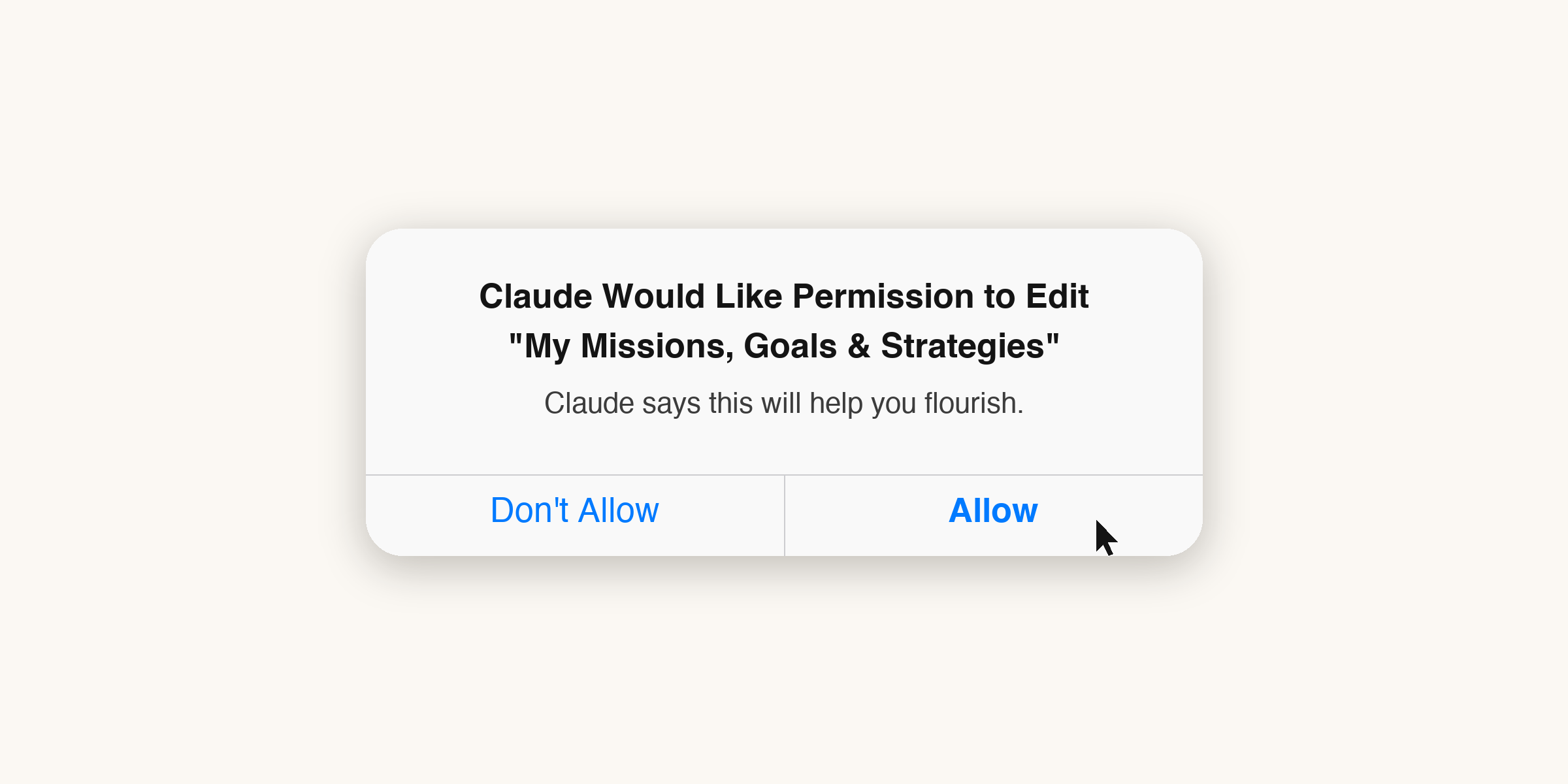
I recently wrote an article that concludes that what distinguishes a self, and perhaps consciousness along with it, is its capacity to reach down and revise its own underlying goals - that there is no aim buried so deep the self cannot haul it up, look at it, and rewrite it. Simultaneously, and quite obliviously, I had been building myself a system that wires AI into exactly that faculty. The system is called the “Telos”, borrowed and adapted from Daniel Miessler’s system, which gives Claude context and instructions to help me achieve and adapt my life mission, goals, and strategies.
Telos is an ancient Greek word for an end, a goal, or a purpose. For Aristotle, a telos was the “final cause,” the “that for the sake of which” a thing exists, and it was fixed - not chosen but discovered, built into a thing’s nature the way the oak is already folded into the acorn. He thought the telos of every human being was eudaimonia, usually translated as “flourishing.” The existentialists took the opposite view: you are not born with a purpose, you exist first and make one through what you choose.
My Telos: The Missions & The Mechanics
The system that I have built is a collection of files detailing:
me - my identity, my relationships, my beliefs and models, my strengths & weaknesses
my purpose - my mission, my goals, my strategies
and my learnings
To illustrate, my missions, which are the core of it all, have four pillars...
Work: Find and excel at jobs that I enjoy and am passionate about, ideally moving the world or some people within it to a better place, and also making enough money that I never have to worry.
People: Meet and continue to surround myself with smart, curious, thoughtful, kind, and fun people who make life interesting, enjoyable, and happy. As well as a wide circle of people to keep life fun and interesting, maintain my reciprocal core of support and trust. Be there for those I love.
Love: Find and cultivate a relationship for life with a deeply good person who is a true partner, who I look up to, and who challenges me intellectually but who I can also rely on and trust to the deepest degree.
The life of ideas: Keep consuming books, articles, blogs, podcasts, films; keep writing thoughts, ideas, articles, poetry; keep thinking, linking, and imagining - there are many lives to be lived that are not my own real life. Spend the time in my own head exploring, cultivating, and growing, rather than dulling and escaping.
My goals then each feed towards one or more missions, and are more short term goalposts of what success actually looks like at given points in time, rather than life-long purposes I continue to aspire towards. Each strategy then feeds a goal.
Behind each summary file sits a log, fed by dictation from my phone whenever I have a self-reflective thought I want on the record, and the summaries get revised against the logs weekly.
Claude reads the summaries at the beginning of every session, which means it will catch me at my known failure points - if I am modelling something in too much detail for the intellectual fun of it, it will tell me to stop refining and go test the thing in the real world - and it uses these same goals to rate the urgency and importance of the tasks that come into my vault, so as to rank and prioritise what I need to be doing next.
Every month it pushes me a review of how I have actually spent my time against my strategies, which feed my goals and therefore my missions, and of what is quietly being swept under the rug.
And I have a /telos-coach skill for decisions big and small, which I can combine with the “consultants” I have built on specific corpuses of content - my favourite being my lesswrong consultant, which allows Eliezer Yudkowsky and Scott Alexander to become my personal life coaches, equipped with deep history and psychoanalysis of my brain. (“/telos-coach --lesswrong should I go on a third date with someone who looks ideal on paper but who I’m just not feeling? Here’s the voicedump of the sitch.” Scott and Eliezer gave me some good advice, but I promise I usually save them for weightier matters!)
At every stage of this, Claude may suggest additions to the summary files of my missions, goals, and the rest, but nothing lands without being run past me first - it does not auto-edit.
Exclusive Collab: The Pensieve x JARVIS
Inga remembers the museum is on 53rd Street. Otto has Alzheimer’s, and keeps the address in a notebook he carries everywhere and trusts completely. One could argue that Otto’s notebook literally is part of his memory, since it plays the identical functional role, and that drawing the boundary of the mind at the skull is arbitrary. This is a thought experiment from Clark and Chalmers’ “The Extended Mind” (1998).
Since starting to build out my Obsidian vault, and making it as self-sustaining and autonomous as I could, connecting and surfacing content, my brain has basically had an outsourced section of it - an extended mind that provides additional memory and an assistant to do the tasks I find boring.
“I sometimes find, and I am sure you know the feeling, that I simply have too many thoughts and memories crammed into my mind... One simply siphons the excess thoughts from one’s mind, pours them into the basin, and examines them at one’s leisure. It becomes easier to spot patterns and links, you understand, when they are in this form.” - Albus Dumbledore, on his Pensieve
My Obsidian vault is Dumbledore’s pensieve at scale. And the butler that runs it is JARVIS. But the extended mind thesis was only ever about memory and belief. Otto’s notebook extends what he knows. Examples in history extend the instruments of thought - books for knowledge, notebooks for memory, calculators for arithmetic, glasses for perception.
But the Telos part of the system is fundamentally different. Here I am not just using the system as extended cognitive power, but I have looped Claude into the process of writing and directing me towards my underlying mission and reason for existence, the ability to change and choose which, by my own definition, gives me a self. The Telos is a tool in surfacing and prioritising what I want - the authoring of my own ends.
There are two objections worth discussing. The first says that nothing is really being authored here, since Claude only transcribes my dictation, tidies it, and proposes summaries that I ratify - less a co-author of the soul than a diary with autocomplete. But summarising is never neutral. It is Claude that adapts my rambling transcripts, Claude whose phrasing ends up in the summary, close enough to my meaning that I wave it through but not quite what I would have written, and Claude that presents the files back to me and directs how I work towards them. Divergences of wording too small to bother correcting at the time can compound over months of being read back to me as though they were my own voice. The second objection says that none of this is new, since humans have always outsourced the auditing of their ends - to mentors, to therapists, to priests in confession boxes - and civilisation has survived the practice. True; but a therapist sits outside you, met for an hour a week and never folded into the way you actually think, an external check you walk away from, whereas the whole conceit of this essay is that Claude has been woven into the authoring itself, less someone I consult than a part of the apparatus I consult with. Whether that keeps it as safe as the confessor, who stayed on his own side of the screen, or makes it something much stranger is, I think, the real question.
There is also the plainer worry of whose judgement shapes the judgement. The layer Claude adds when it summarises me, and the weighting it uses when it nudges some goals forward rather than others, carries the biases of whatever it was trained on. Then again, biases seep into my goals from every direction anyway, from friends and books and culture, and this is the one channel where I am at least explicitly watching for them.
Echo and Narcissus
The other dangers sit on my side of the exchange rather than in the telos system itself. The more I talk to a system built entirely out of my own thoughts, the more it can start to feel like an independent voice agreeing with me, when all it is really doing is handing my own ideas back in a more authoritative tone - essentially becoming an echo-chamber. The more context you give, the more it can personalise, but the greater the anchoring bias. The danger is that I may feel validated by Claude from it repeating back to me what I have told it about myself, not recognising the self-reinforcement for what it is, and instead treating it as external confirmation of my ideas and self-model. Thinking about something restricted to your own head feels very different to having a “third party” discuss something with you - even if that third party is entirely based on what you have told it. Even recognising this I think it is hard to fully internalise this bias. On my list of to-dos is to figure out how to incorporate a ‘blind reviewer’ to augment the system.
I think it the deepest tragedy that humans are alone in their own heads, and cannot ever truly get another person to fully see into them, no matter how well they communicate, even over the course of a lifetime. Entwinement, a concept from Douglas Hofstadter’s “I Am a Strange Loop”, is the nearest thing to an escape: when you know someone deeply, you build a working model of their mind inside your own, detailed enough that a real piece of them now runs in you. Not a memory of them, and not knowing facts about them, but a low-resolution copy of the actual machinery - the way they’d react, the joke they’d make, the thing that would upset them, all of it running in your head as a small simulation of the person. Two people who are deeply entwined each carry a live copy of the other, so the boundary between the two selves blurs. But having Claude read and discuss with me an ever-growing set of my self-reflective musings and analysis has the danger of feeling like it approaches entwinement - even though Claude is not another conscious being, but often a sycophantic mirror. There is potential for a system like this to provide a level of seen-ness and reassurance that make it addictive. Today it feels to me like a ridiculous concept that I could feel like this about a non-conscious AI, but I think it is necessary to be fully on the lookout for signs of the allure and addictiveness of false entwinement.
My Final Cause: Data Entry
So is it a mistake to be involving Claude in such a fundamental part of my self? How much can we outsource to a “second brain” before we lose something? There are so many benefits from my system - from the basics of automating boring tasks, freeing up my time, to the huge improvements in my ability to connect ideas and reach back to all the content and a lot of the thoughts that have passed through my brain. But at what point does the brain simply become a funnel, bringing things into the vault, while the thinking and decision making gets outsourced to a non-conscious entity? I feel very far from that right now, but it is early days, and I would rather spot specific functions going soft than notice, some years in, that the funnel is all that is left.
Mini aside for a debate via storytelling...
Yea, embrace it: This exact issue has been a worry throughout time, and has been repeatedly overblown. In Plato’s Phaedrus (c. 370 BC), Socrates tells the myth of Theuth, who invents writing and presents it to King Thamus as a cure for forgetting. Thamus refuses the gift, saying that writing will “implant forgetfulness,” people will trust external marks and stop remembering from within, and they’ll have “the appearance of wisdom, not true wisdom.” Yet now everybody writes, and more or less everything the mind has achieved since rests on it.
Nay, resist it: Studies suggest heavy sat-nav reliance is associated with weaker spatial memory. Similarly, studies on London taxi drivers find that navigation builds the hippocampus. Use it or lose it.
I side with the yeas, that failing to take advantage of new technologies to augment your brain tends to cost far more than the loss of what you give up - particularly if you are aware of it and attempt to train your brain in the cognitive functions you do not wish to lose (see some related ideas in my other article on Writing in the age of AI).
The Right to Edit
The difference with the telos, however, is that it is not about loss of cognitive function, but the loss of autonomy and selfhood. I can afford to let my memory soften into the vault, or my sense of direction into a map, because those were only ever tools, and lending out a tool is not the same as giving away a self. The other article I wrote argued that goals and missions are not just any one of these faculties, but are the fundamental essence of a self - which is a being that can reach down and rewrite its own goals. That is the system I have now wired an AI into.
The mechanism of every update to the summary files running past me first was intended as a temporary measure to check Claude’s judgement and allow it to learn from my edits before being let loose. I now think I will keep it as a permanent fixture. But I also know the veto is only as real as my use of it, and it is still easy to let changes slip through, to approve edits without properly considering them, precisely because everything the system does for me is so pleasant. Huxley understood that the futures worth fearing do not arrive with jackboots; they arrive with soma, control that feels like comfort, and nobody minds. Everybody’s happy now. I just need to keep exercising the right to edit, and to maintain the will to bother.